
Best Methods to Prevent Bolt Loosening: Lock Nuts, Adhesives, and Advanced Fastening Solutions
Why Bolt Loosening Is a Serious Engineering Problem
Bolt loosening is one of the most common causes of mechanical failures in industrial equipment, transportation systems, infrastructure, and heavy machinery. When a bolted joint loses preload, components can shift, vibrate, wear prematurely, or even fail completely.
Research and industry testing have shown that transverse vibration is one of the primary causes of self-loosening in bolted joints. Under repeated vibration and dynamic loading, fasteners can gradually lose clamping force, increasing maintenance costs and creating safety risks.
To prevent these failures, engineers use a variety of fastening solutions, each designed to address different causes of bolt loosening.
What Causes Bolts to Loosen?
A properly tightened bolt functions like a spring, generating clamping force that holds components together. Problems begin when that preload decreases due to:
- Continuous vibration
- Shock and impact loads
- Thermal expansion and contraction
- Joint settlement and embedment
- Repeated loading cycles
- Rotational movement between threads
As preload decreases, the likelihood of fastener rotation and joint separation increases.
Method 1: Nylon Insert Lock Nuts
Nylon insert lock nuts, commonly called Nylock nuts, use a nylon ring that creates friction against the bolt threads.
Advantages
- Low cost
- Easy installation
- Widely available
- Suitable for light-duty applications
Limitations
- Locking performance depends on friction
- Nylon inserts can wear over time
- Performance may degrade under high temperatures
- Typically require replacement after repeated use
For equipment exposed to significant vibration, friction-based locking methods may not provide long-term reliability.
Method 2: Thread-Locking Adhesives
Thread-locking compounds are liquid adhesives applied to bolt threads before assembly.
Advantages
- Effective for many general-purpose applications
- Fills thread gaps
- Helps resist vibration-induced loosening
Limitations
- Requires proper surface preparation
- Can complicate maintenance and disassembly
- Performance depends on application quality
- Chemical exposure and temperature may affect effectiveness
Adhesives are commonly used in manufacturing but may not be ideal when frequent maintenance or repeated disassembly is required.
Method 3: Lock Washers
Lock washers are designed to increase resistance to loosening through spring force or surface engagement.
Common types include:
- Split lock washers
- Toothed lock washers
- Wedge-lock washers
Advantages
- Simple installation
- Cost-effective
- Useful in many general applications
Limitations
- Performance varies significantly by design
- Some lock washers primarily delay loosening rather than prevent it
- May not maintain preload under severe vibration
Engineers increasingly favor advanced wedge-locking technologies in high-vibration environments where preload retention is critical.
Method 4: Double Nut (Jam Nut) Systems
A jam nut system uses two nuts tightened against each other to create locking force.
Advantages
- Reusable
- No adhesives required
- Effective in many industrial applications
Limitations
- Requires additional installation time
- Proper tightening procedure is critical
- Can be difficult to access in confined spaces
Jam nuts remain a practical solution for many applications but require careful installation to achieve consistent results.
Method 5: Mechanical Wedge-Locking Nuts
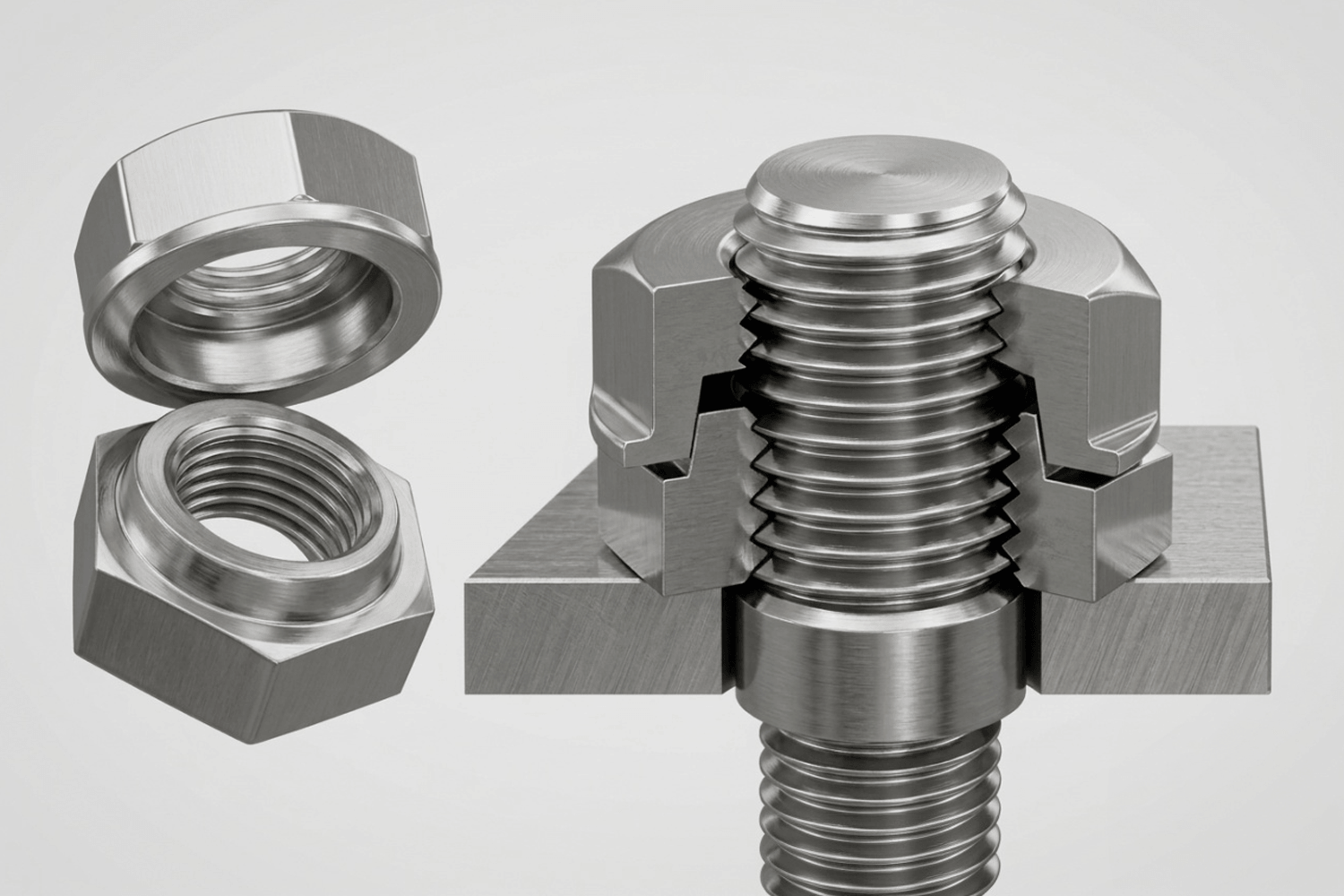
Mechanical wedge-locking systems address the root cause of rotational loosening by eliminating thread clearance rather than relying solely on friction.
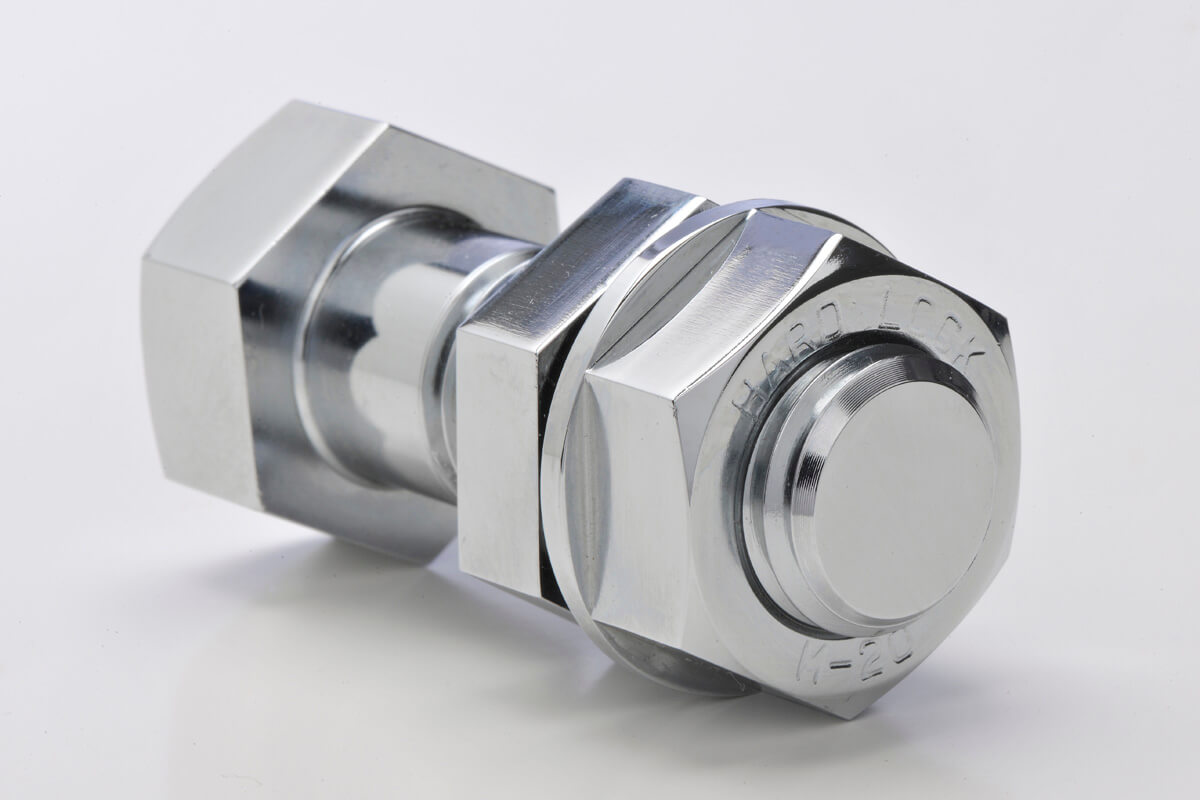
One example is the HARDLOCK Nut, which uses a two-piece convex and concave nut design that creates a mechanical wedging force against the bolt threads. This design helps maintain preload even under severe vibration and dynamic loading.
Advantages
- Resistant to vibration-induced loosening
- Does not rely solely on friction
- Reusable
- Suitable for safety-critical applications
- Proven performance in vibration testing
Limitations
- Higher initial cost than conventional lock nuts
- May exceed requirements for low-risk applications
Comparing Common Bolt Loosening Prevention Methods
| Method | Reusable | Vibration Resistance | Maintenance Friendly |
|---|---|---|---|
| Nylon Insert Lock Nuts | Limited | Moderate | Moderate |
| Thread-Locking Adhesives | No | Moderate to High | Low |
| Lock Washers | Yes | Moderate | High |
| Jam Nuts | Yes | High | Moderate |
| Mechanical Wedge-Locking Nuts | No | Very High | High |
The best solution depends on operating conditions, maintenance requirements, safety concerns, and lifecycle costs.
How Engineers Evaluate Fastener Performance
One of the most widely recognized methods for evaluating anti-loosening performance is the Junker Test, which applies transverse vibration to a bolted joint while measuring preload retention.
Because transverse vibration is a leading cause of self-loosening, Junker testing provides valuable insight into how different fastening systems perform in real-world conditions. Standards such as DIN 65151 and ISO 16130 are commonly used for these evaluations.
Choosing the Right Solution for Your Application
When selecting a bolt locking method, consider:
- Vibration levels
- Shock loading
- Maintenance frequency
- Environmental conditions
- Safety requirements
- Lifecycle costs
For low-vibration applications, conventional lock nuts or adhesives may be sufficient. For rail systems, mining equipment, heavy manufacturing, infrastructure, and other vibration-intensive environments, mechanical locking solutions often provide superior long-term reliability.
Looking for a Proven Anti-Loosening Solution?
HARDLOCK NUT USA provides advanced mechanical wedge-locking technology designed to resist loosening in demanding environments. By eliminating thread clearance and maintaining clamping force, HARDLOCK Nuts help improve safety, reduce maintenance, and extend equipment reliability in critical applications.
©中小機構公式チャンネル(SMRJ:独立行政法人中小企業基盤整備機構): HARDLOCK Industry Co., Ltd.[J-GoodTech]
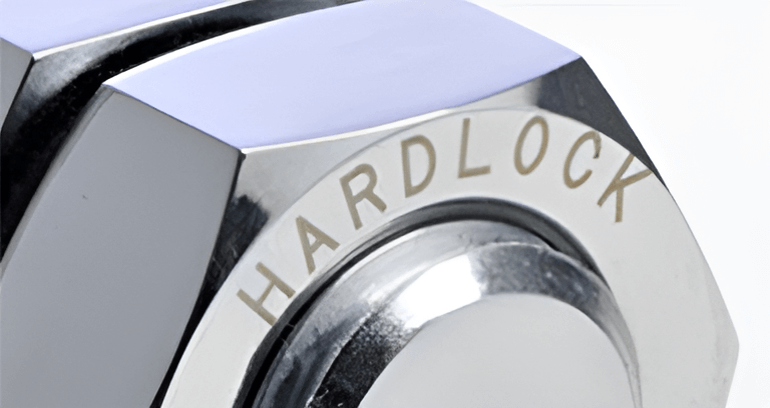
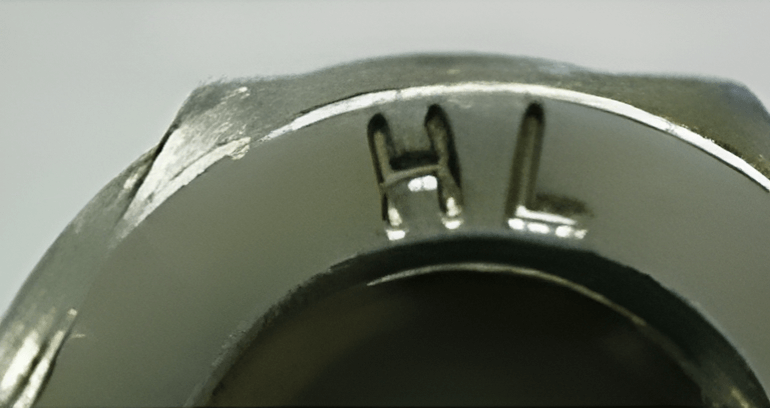
⚠️ Quality issues caused by counterfeit products can result in serious and costly consequences for your business. Please exercise caution and choose genuine HARDLOCK solutions.
*A-Lex International Marketing is an authorized distributor for HARDLOCK Industry Co., Ltd.