
HARDLOCK Nut vs. Wedge Lock Washers: Which Vibration-Proof Fastener Is Right for You?
When engineers search for a vibration-proof fastening solution, two names come up more than almost any other: HARDLOCK Nuts and wedge lock washers. Both are established, tested solutions used in demanding industrial applications, and both solve the same core problem — bolts loosening under vibration — using very different mechanical approaches.
This comparison looks at how each system actually works, where each one is best suited, and what to consider when specifying one over the other.
How Wedge Lock Washers Work
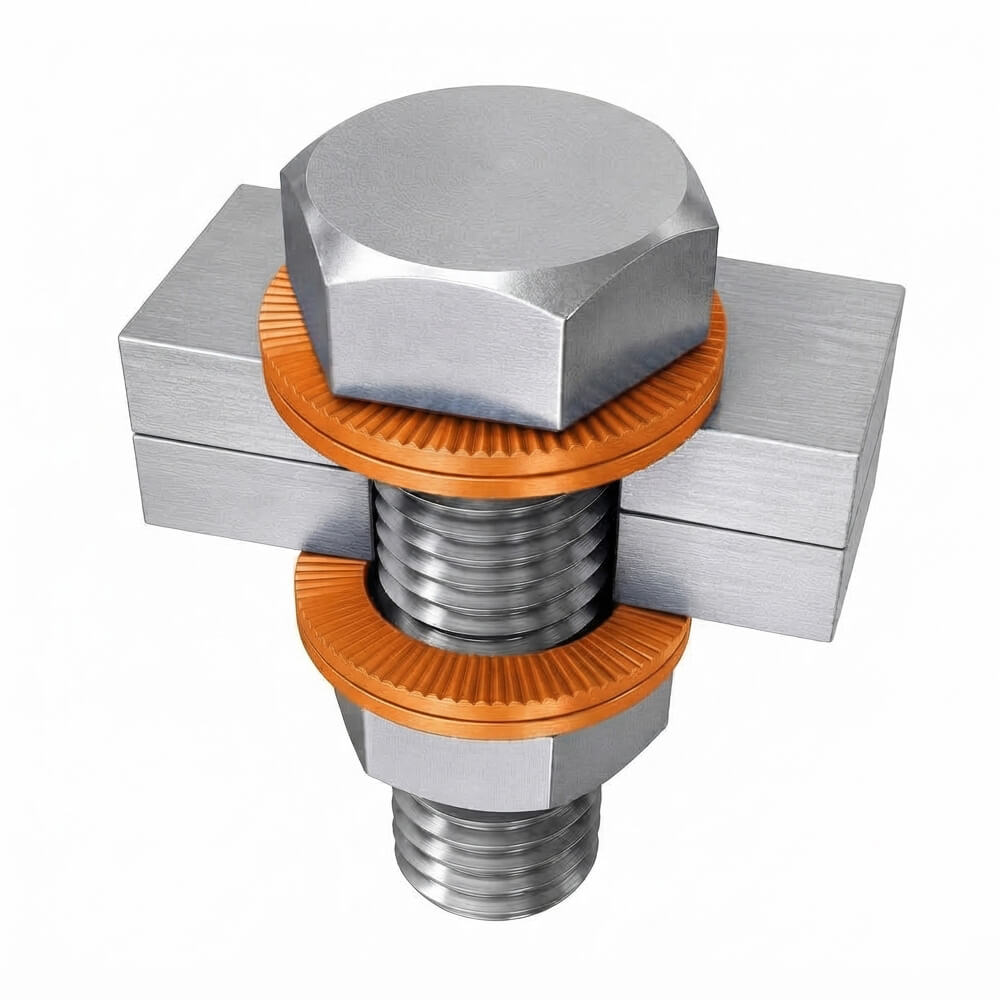
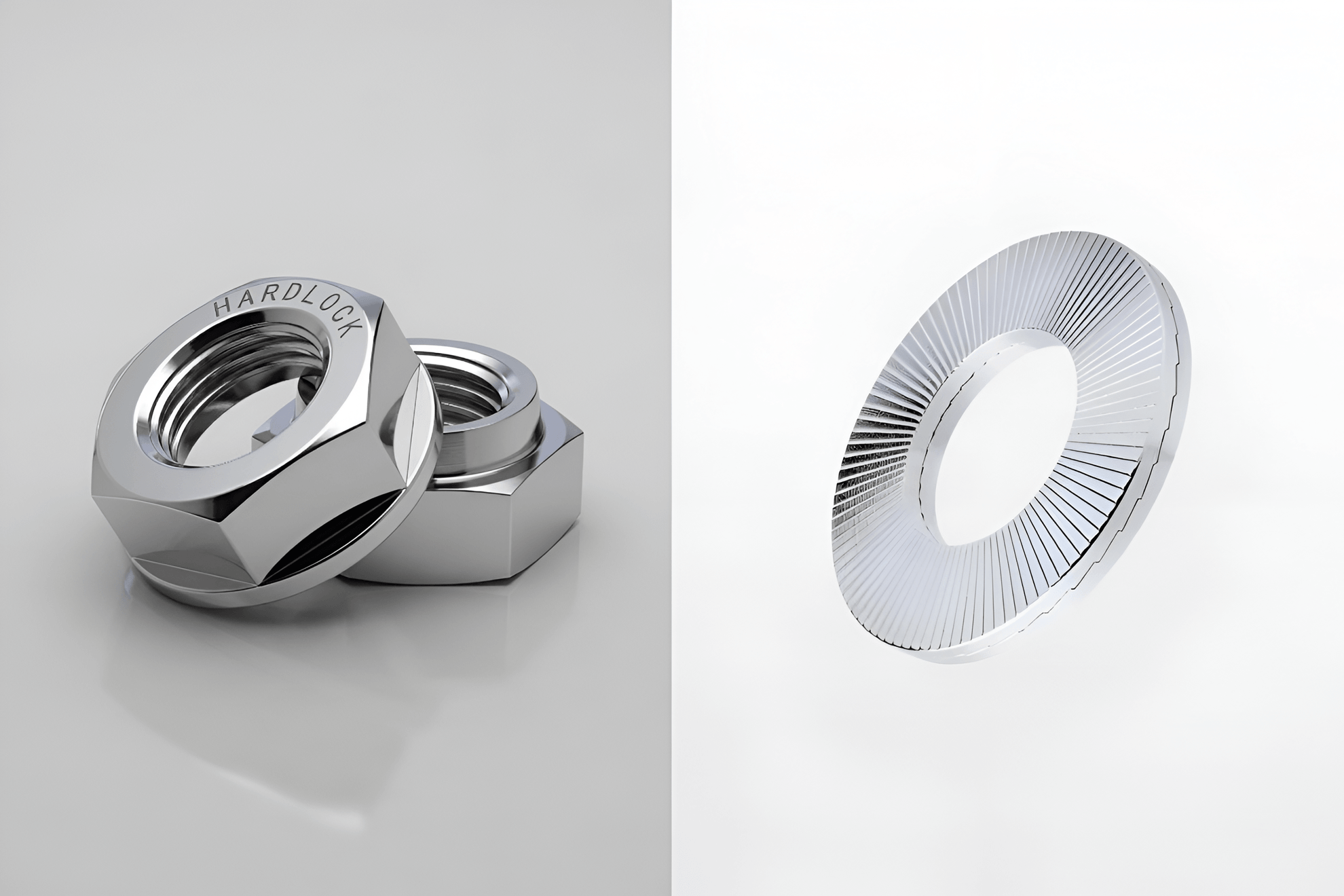
The wedge lock washer system uses a pair of wedge-shaped washers installed with the cam faces (the ridged sides) facing each other and the smooth sides facing outward, against the bolt head and the joint surface. The wedge angle between the two washers is steeper than the thread pitch of the bolt. When the joint experiences vibration and the bolt begins to rotate loose, the washer pair is forced to expand rather than allow the bolt to back off — because the wedge angle makes loosening require the washers to physically stretch, which they resist.
This is a friction-and-geometry-based solution added to a standard nut and bolt, rather than a replacement nut design. It’s installed as a washer pair under a conventional nut or bolt head.
Strengths:
- Works with standard, off-the-shelf nuts and bolts — no special nut geometry required
- Well-established in wind energy, heavy equipment, and structural applications
- Doesn’t rely on adhesive or chemical bonding, so it isn’t affected by cure time or temperature limits the way threadlockers are
- Widely available in a broad range of sizes and material grades
Considerations:
- Requires two washers per joint in addition to the standard nut and bolt, adding parts count and installation steps
- Correct orientation (cam faces together) is essential — installed backward, the washer pair provides little to no locking benefit
- Adds stack height to the joint, which can matter in space-constrained assemblies
- Performance depends on maintaining the wedge geometry under load; extremely high loads or repeated heavy impact can affect long-term wedge engagement
How the HARDLOCK Nut Works
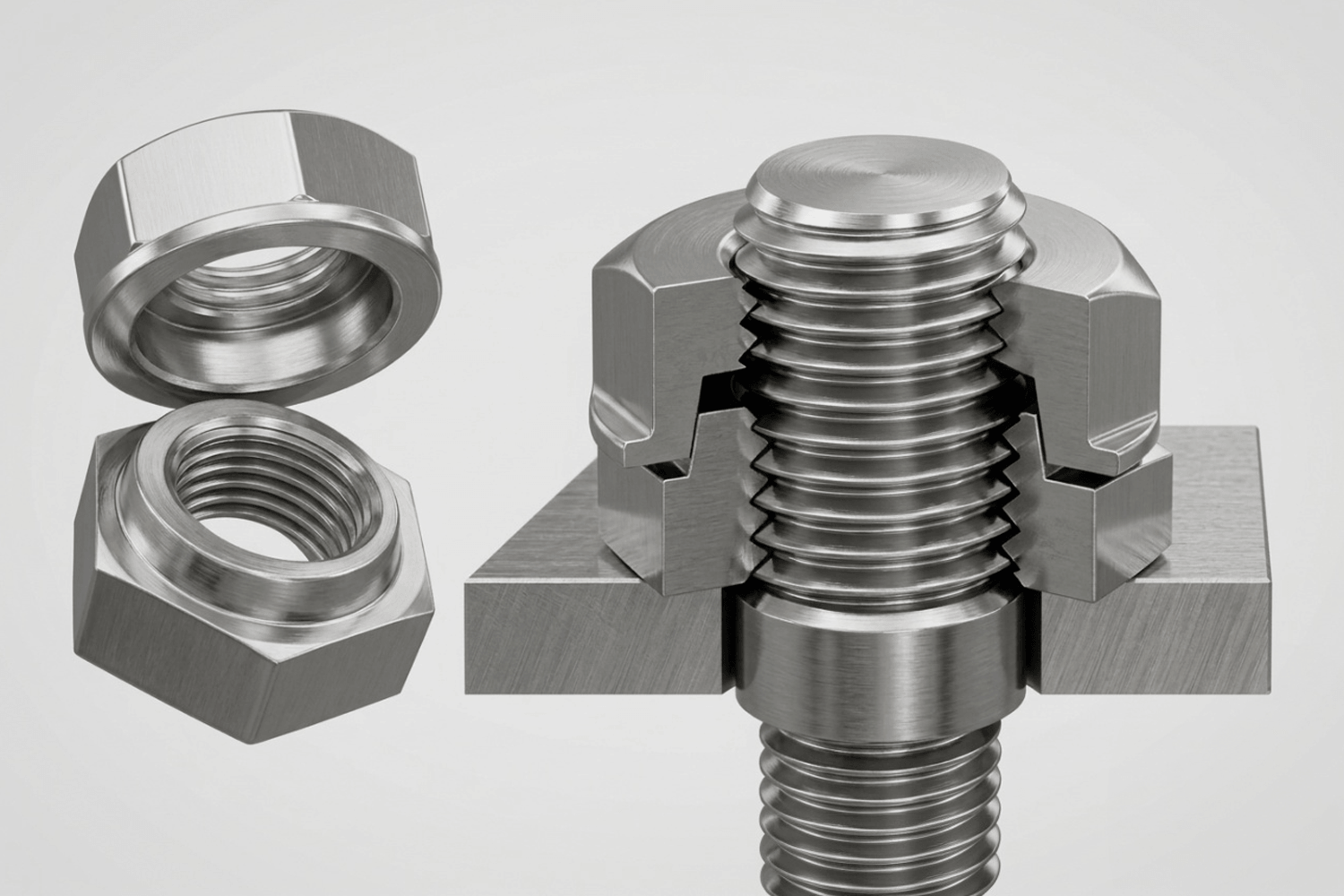
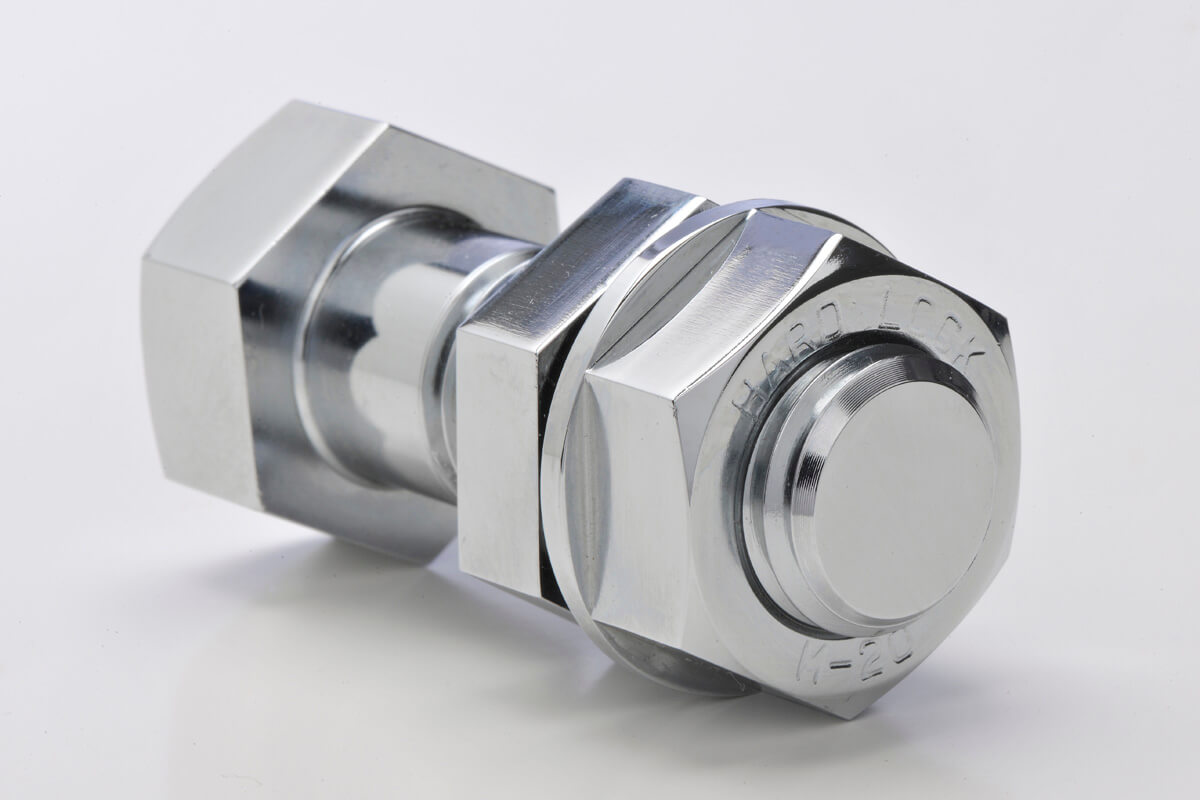
The HARDLOCK Nut takes a different approach: instead of adding washers to a standard nut, it replaces the nut itself with a two-piece design. A convex nut, with an off-center truncated protrusion, is paired with a concave nut containing a matching conical recess. As the concave nut is tightened down onto the convex nut, the protrusion is driven sideways against the bolt threads, generating a transverse locking force that holds the joint independent of vibration direction.
Strengths:
- Single fastener replaces the standard nut — no additional washers or parts required
- Generates locking force through direct thread engagement rather than external wedge geometry
- Reusable without loss of performance, provided a proper reinstallation gap (roughly one thread pitch) is maintained
- Tested against DIN 65151 (Junker transverse vibration test) and NAS aerospace loosening standards
- Compact axial footprint compared to a nut-plus-washer-pair stack
Considerations:
- Requires the specific convex/concave nut pairing rather than a standard hex nut, so it needs to be specified and sourced as a matched set
- Higher per-unit cost than a standard nut, though often comparable to or less than a nut-plus-washer-pair assembly once installation labor is factored in
- Less commonly stocked by general fastener distributors compared to standard hardware, since it’s a specialized locking nut rather than an add-on component
Where They Overlap
Both systems are genuine engineering solutions to vibration loosening, not friction-only stopgaps like nylon inserts or serrated flange nuts. Both are used in serious industrial applications — wind turbines, heavy machinery, rail and structural infrastructure — where failure carries real safety and cost consequences. Neither relies on chemical bonding, so neither is affected by the cure-time or temperature limitations of thread-locking adhesives.
Key Differences to Consider
Parts count and installation.
The wedge lock washer system adds two washers to an otherwise standard nut and bolt. The HARDLOCK Nut replaces the nut entirely as a single two-piece unit. If minimizing part count, stack height, or installation steps matters for your assembly, that’s worth weighing directly against your specific joint design.
Mechanism type.
Wedge lock washers resist loosening through wedge geometry that resists washer expansion. HARDLOCK resists loosening through direct transverse force applied at the thread interface. Both are mechanical, non-friction-reliant solutions, but they achieve the lock through different physical principles — which is worth understanding if your application has unusual load or orientation conditions.
Orientation sensitivity.
Wedge lock washers must be installed with the cam faces oriented correctly to function; incorrect installation significantly reduces effectiveness. HARDLOCK’s two-piece nut design has a defined tightening sequence (concave nut first, then convex) but doesn’t have the same washer-orientation failure mode.
Reuse.
Both systems are designed to be reusable rather than single-use, unlike nylon inserts, which typically shouldn’t be reused. Confirm current manufacturer guidance for reuse limits and reinstallation procedure for whichever system you select.
Sourcing and standardization.
The wedge lock washer-pair approach works with hardware you may already have on hand. HARDLOCK’s nut pairs need to be specified and sourced as a set, which is a consideration for existing equipment with established bolt specifications versus new designs where the fastener can be specified from the start.
How to Decide
- If your design already uses standard bolts and you want to add vibration resistance without changing the fastener itself, a washer-based system may integrate more easily into an existing bill of materials.
- If you’re designing a new assembly, need a compact axial footprint, or want to reduce total parts count and installation steps, a two-piece self-locking nut is worth evaluating directly against the washer-pair approach.
- If reuse during scheduled maintenance is a priority, confirm current reuse specifications for both systems for your specific bolt size and application, since guidance can vary by load and cycle count.
- If you need independently documented test results for a specific standard (DIN, ISO, NAS, or others relevant to your industry), request the current test data sheet from each manufacturer rather than relying on general marketing claims.
The Bottom Line
Both the HARDLOCK Nut and wedge lock washers are credible, widely used solutions to a real engineering problem, and the right choice often comes down to your specific joint design, existing hardware standards, and installation constraints rather than one system being universally superior. For applications where a single-component, reusable, all-metal nut with documented transverse vibration testing fits your design better than a washer-pair add-on, the HARDLOCK Nut is worth a closer look.
To review test data, dimensions, and specifications for your application, request a quote or technical consultation.
©HARDLOCK Industry Co., Ltd.: JUNKER LOOSENING TEST
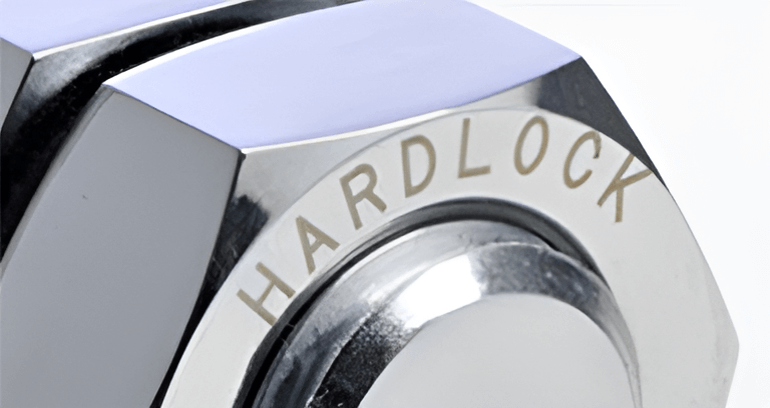
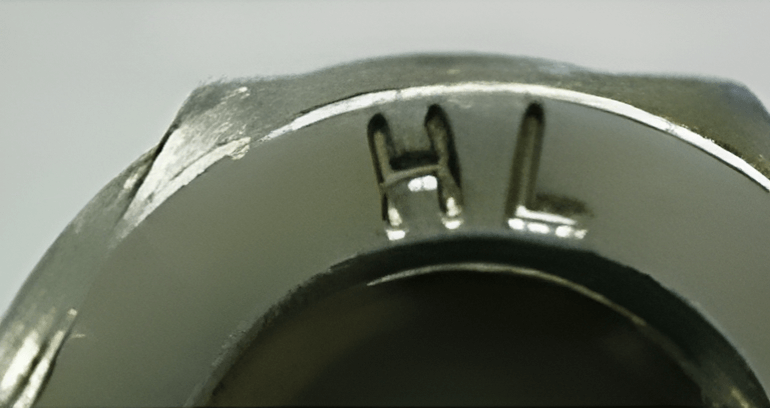
⚠️ Quality issues caused by counterfeit products can result in serious and costly consequences for your business. Please exercise caution and choose genuine HARDLOCK solutions.
*A-Lex International Marketing is an authorized distributor for HARDLOCK Industry Co., Ltd.